For those running a Star Labs StarFighter Ultra or other Intel Core Ultra Arrow Lake laptop, the recent Ubuntu 26.10 release is providing some nice performance gains over the Ubuntu 26.04 LTS release. Here is a look at how Ubuntu 26.04 LTS vs. Ubuntu 26.10 performs with the Intel Core Ultra 9 285H over dozens of different benchmarks.
The Linux Foundation published a new study today around the impact of generative AI on open-source software development. One key takeaway is that ~25% of new open-source software pull requests amount to AI slop...
Added to the Linux kernel last year was Coredump support via Unix domain sockets as an alternative to the pipe-based Coredumps. With code now merged for Linux 7.4, the core dumps via sockets has the potential of being much smaller thanks to sparse support. In extreme cases they can be 1% of the size without sparse support...
Muse, the new general-purpose AI agent from Meta, can expose sensitive information when users share conversations through Web links, researchers reported Monday.
Like many online services, Muse allows users to share searches, conversations, images, and similar content with other people. Such share features usually involve clicking an option to create a unique URL that anyone can use to load a page hosting the content. To keep potentially sensitive information from being accessible to unintended people, the URLs typically contain a long sequence of text that can’t be easily guessed.
A single query is all that's required
Muse, which Meta CEO Mark Zuckerberg said last month was “built from the ground up for privacy and security,” seems to take the same precautions. But a central design decision for constructing URLs has made the links easy to discover. As a result, researchers from security firm Claroc said they were able to enumerate 6,800 links Muse users created for sharing conversations with others. After opening a few hundred of them, the researchers found information that was clearly not intended to be publicly available, including:
Linus Torvalds began honoring pull requests overnight of new code entering the Linux 7.4 kernel -- as well as removing old code. BFS is the latest obsolete file-system removed from the mainline kernel...
The Omarchy Linux distribution to date has been centered on x86_64 support for this Arch Linux distribution. Released today was Omarchy 4.5-RC1 and with this new version there is initial AArch64 support centered around Snapdragon X and NVIDIA N1X laptop support...
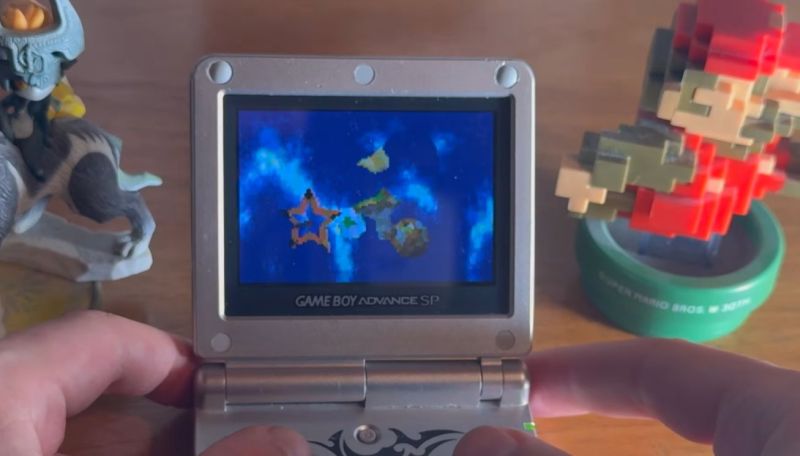
Joining the ranks of fresh backported Nintendo games is Super Mario Galaxy for the Nintendo Game Boy Advance (GBA), courtesy of [Tobias Friedly], AKA [Tobi]. In a recent video he announces the release of this game, along with the release of the source code of the engine and all the game’s code in a GitHub project.
Naturally none of the original Wii game’s assets are provided to appease Nintendo’s vicious lawyers, so you’re expected to bring your own super-legally acquired ISO image or equivalent to fill in these blanks when you build your ROM for the GBA.
This is a mostly complete port, even integrating the star pointer despite the GBA’s limited number of controls compared to the Wii. In some situations it’s opted to have star bits automatically collected to work around this limitation, which is probably a quality-of-life improvement that many SMG players will appreciate.
For the game’s logic a lot of code was borrowed from the recently decompiled version of the original game, which saved a lot of time even if the GBA’s hardware is no match for the Wii’s. From the gameplay in the video it definitely looks like a playable version of the game, with an acceptable frame rate that looks to be worth a try.
As I sat in the cab of the pickup truck and manually rolled down the windows, I closed my eyes and flashed back to opening the windows on a cold, winter day in my dad’s 1975 Ford Ranger to let more cigarette smoke escape. The memory faded as I opened my eyes and looked through the windshield at a wall in the Slate Customer Experience Center studded with bright color chips.
Last week, in a former Tesla store staffed by some former Tesla employees, Slate opened its first showroom. Located in the Fulton Market District just northwest of the Chicago Loop, the Slate Experience Center is a place for would-be buyers to poke around a prototype, check out customization options, buy some Slate merch, and even pre-order a new Slate Truck with a $300 deposit.
Designed for the American obsession with pickup trucks, the Slate Truck is a bare-bones electric pickup truck retailing for $24,950. It sports plastic panels, a minimalist interior design sensibility, actual window winders, and a projected range of 205 miles. Ars got to go for a ride in a Slate Truck over the summer, but we haven't had a chance to shop for one. So I stopped by the Slate Experience Center so I could, er, experience the Slate.
Microsoft has reportedly abandoned plans to serve as the anchor customer for Britain's largest proposed AI supercomputer after learning that the project's Essex data center might not receive sufficient grid power until the early to mid-2030s. "Its departure leaves Nscale without a publicly announced customer for the site, although the neocloud insists the project is still going ahead," reports The Register. From the report: When the deal was announced in September 2025, the plan was to pack 23,040 Nvidia GB300 GPUs into a 50MW facility, with room to expand to 90MW. Microsoft would use the computing power for its Azure cloud services, with the first chips expected in early 2027. One important detail remained: how to power it.
As The Guardian reported last month, UK Power Networks warned Nscale that the grid capacity needed might not be available until the 2030s. A UK Power Networks spokesperson told The Register it could not discuss individual connections due to obligations under Section 105 of the Utilities Act. "However, in general, many datacenters, whilst they can connect to our distribution network, are awaiting works on the national transmission network which we do not own," the spokesperson said.
Nscale, meanwhile, isn't letting the small matter of losing its biggest customer dampen its enthusiasm. "We remain committed to both the Loughton project and the UK and we are exploring alternative power sources for the site, in addition to other expansion sites in the UK. Our relationship with Microsoft remains strong and long-term, and this unfortunate London-wide grid issue has no impact on our other contracts," Nscale told The Register.
Linux 7.4 is seeing a new emulation function added for cmpxchg() for compare and exchange. This is being done so that two-byte cmpxchg() can be used in common Linux kernel code that is already natively supported on newer CPU architectures. The pull request notes though that these old CPU architectures might no longer be supported by the Linux kernel moving ahead...
Miguel Ojeda sent out his pull request of the new Rust kernel code slated for introduction in Linux 7.4. It's a big one this round due to updating the Zerocopy vendored library plus updating other Rust crates for the kernel...
Brothers and sisters: You were at that time without Christ, alienated from the community of Israel and strangers to the covenants of promise, without hope and without God in the world. But now in Christ Jesus you who once were far off have become near by the Blood of Christ.
For he is our peace, he made both one and broke down the dividing wall of enmity, through his Flesh, abolishing the law with its commandments and legal claims, that he might create in himself one new person in place of the two, thus establishing peace, and might reconcile both with God, in one Body, through the cross, putting that enmity to death by it. He came and preached peace to you who were far off and peace to those who were near, for through him we both have access in one Spirit to the Father.
So then you are no longer strangers and sojourners, but you are fellow citizens with the holy ones and members of the household of God, built upon the foundation of the Apostles and prophets, with Christ Jesus himself as the capstone. Through him the whole structure is held together and grows into a temple sacred in the Lord; in him you also are being built together into a dwelling place of God in the Spirit.
R. (see 9) The Lord speaks of peace to his people. I will hear what God proclaims; the LORD–for he proclaims peace. Near indeed is his salvation to those who fear him, glory dwelling in our land. R. The Lord speaks of peace to his people. Kindness and truth shall meet; justice and peace shall kiss. Truth shall spring out of the earth, and justice shall look down from heaven. R. The Lord speaks of peace to his people. The LORD himself will give his benefits; our land shall yield its increase. Justice shall walk before him, and salvation, along the way of his steps. R. The Lord speaks of peace to his people.
Jesus said to his disciples: “Gird your loins and light your lamps and be like servants who await their master’s return from a wedding, ready to open immediately when he comes and knocks. Blessed are those servants whom the master finds vigilant on his arrival. Amen, I say to you, he will gird himself, have them recline at table, and proceed to wait on them. And should he come in the second or third watch and find them prepared in this way, blessed are those servants.”
If you are one of those people who visualize things physically better than in the abstract, then Regex Marble Run by [bottomless] might be for you. You enter a test expression and a string, and the site generates a virtual marble machine that lets you see the regular expression pick apart the string in a physical way.
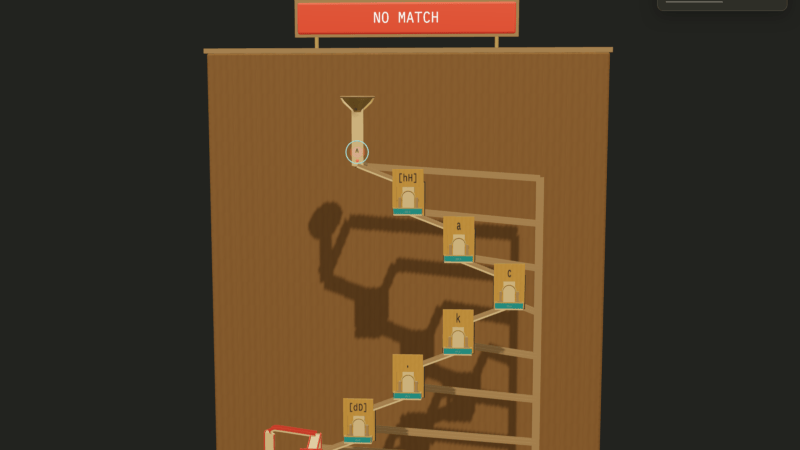
Click this link, and you’ll see the regular expression “^[hH]ack.[dD][^0-9]*$” which, if you aren’t a regular expression user, might seem a bit cryptic. However, it is fairly simple if you take it bit-by-bit.
The caret character tells it to match the start of the string. So “^dog” will match “dog” and “dog food” but won’t match “food for a dog.” The following bit “[hH]” will match either “h” or “H”. Then there is “ack” which is just what you think it is. So a string starting with “hack” or “Hack” might match (depending on the rest of the expression.
The period means match any single character. Then there’s another “[]” but this time with “dD” to match any kind of D. The next “[]” character class is a range from 0-9, but since there is a caret, the match is negated. So “[^0-9]” means match anything except a digit from 0 to 9. The “*” means we can have zero or more of these. So “HackxD” matches, but so does “HackxDXYZabc” for now. Trick question: Does “HackxDXYZabc123” match? So far, yes, but it only matches to the lowercase “c” character.
The final character, “$” means end of string. So now “HackxDXYZabc123” does not match because we are still in the middle of the string. However, “HackxDXYZabc” will match since the previous “*” “ate” the rest of the string.
Head spinning? The site will let you see each letter of a test string as a marble that falls through the different parts of the regular expression. Balls that pass wind up in the left-hand box, while failures are in the right-hand box. Will it help you? We don’t know, but it is fun to watch.
Japan has successfully launched its Martian Moons eXploration (MMX) mission to study Mars' two moons, Phobos and Deimos. Scheduled to arrive in August 2027, "MMX will become the first spacecraft to land on and return samples from Phobos for study back on Earth, which scientists think could shed light on a decades-old mystery about the moons' origins" and resolve whether they were formed from a giant impact or were captured asteroids, reports Space.com. From the report: It was the 10th liftoff of Japan's expendable, two-stage H3 rocket, which was jointly developed by JAXA and Mitsubishi Heavy Industries. After clearing its launch pad today, the 207-foot-tall (63 meters) launch vehicle flew a nominal trajectory through its ascent corridor over the Pacific Ocean, jettisoning its four solid boosters in pairs just before the flight clock reached two minutes. The rocket shed its payload fairings about one minute and 20 seconds later, exposing MMX to the vacuum of space for the first time. [...] MMX is now under its own power, and on course for Mars.
The interplanetary transit will last about 10 months, with the spacecraft scheduled to arrive at the Red Planet in August 2027. When it does, MMX's propulsion module will execute an orbital insertion burn to place itself in a quasi-satellite orbit (QSO) around Phobos, which places MMX within the space around the moon as both circle Mars. MMX will spend about three years in the Martian system, devoting much of that time to studying the 14-mile-wide (22 km) Phobos with its science instruments. The spacecraft also carries the IDEFIX rover, a joint effort of the space agencies of France and Germany, which is scheduled to deploy to the surface of Phobos in late 2028 or early 2029.
After a mapping campaign to select suitable landing sites, MMX will perform two separate touchdowns on Phobos to collect and stow samples in the spacecraft's return capsule. Following its second landing and sample collection, MMX will briefly return to QSO with Phobos before transferring to a more elongated orbit around Mars that intersects with the planet's smaller moon, Deimos, which is just 8 miles (14 km) in diameter. During the last several months of its time around Mars, MMX will perform a series of Deimos flybys before departing for Earth in November 2030. If all goes according to plan, the MMX sample-return capsule will land in Australia in 2031. You can watch a recording of the launch on YouTube.
Japan launched a $578 million mission Monday on a five-year expedition to land on the largest moon of Mars and retrieve samples for return to Earth, a daring international project that could yield new insights into the formation of the Solar System.
The robotic Martian Moons eXploration mission, known as MMX, lifted off at 3:41 pm EDT Monday (4:41 am Japan Standard Time Tuesday) from Tanegashima Space Center in southern Japan.
The MMX spacecraft rode into orbit atop a 207-foot-tall (63-meter) H3 rocket, Japan's flagship launch vehicle. The rocket assigned to MMX debuted a new souped-up configuration with four strap-on solid rocket boosters, full-throttle main engines, and an extended payload shroud to accommodate the demands of Japan's heaviest and most ambitious interplanetary mission to date.
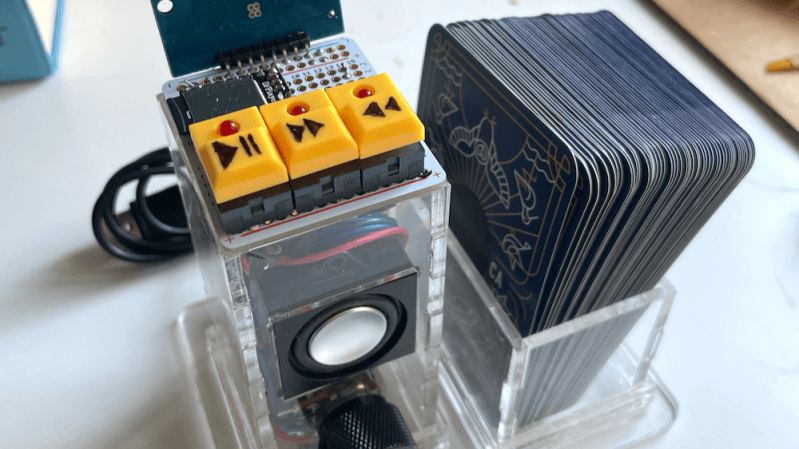
All [Hannah Robertson]’s Birduino needs is for one to tap an NFC-enabled card to the reader, and the device plays one of the vocalizations associated with the bird shown on the card. It ties together a few different components into a whole, and acts as a good reference design for similar work. There are a few time-saving construction tips worth keeping in mind, too.
The major components are an Arduino Nano, an RC522 RFID reader, and an MP3 player module. Using hardware modules and breakout boards means simpler wiring and being able to take advantage of existing libraries and sample code. There are also a few other things in this build that avoid re-inventing the wheel.
A deck of bird cards plus a roll of NFC stickers equals a ready-to-scan assortment without having to design it oneself.
Rather than design, print, and cut a set of bird cards, [Hannah] found a set of bird-themed playing cards with a different North American bird on each. The back of each card gets an NFC sticker off a big roll purchased online. The result? A set of NFC-enabled bird cards with a minimum of work and fuss. The RC522 RFID reader doesn’t fully support NFC, but it works well enough to read the ID off the stickers.
When the user touches a card to the reader, the device plays one of the vocalizations from a collection of sounds for each bird. Creating the manifests and linking each card’s ID to them was a lot of manual work, but the result is great. The sound themselves come from the Cornell Guide to Bird Sounds of the United States and Canada, a $20 USD curated compilation of vocalizations from a staggering 908 bird species of North America. In a way, the biggest bottleneck is the card deck itself. At 52 cards plus two Jokers, it contains only a small subset of the total birds in the Cornell collection.
The enclosure is laser-cut clear acrylic, and here [Hannah] offers some time- and money-saving advice for anyone looking to glue acrylic to acrylic in a way that doesn’t frost or cloud the clear acrylic: Clear Gorilla Glue Gel. There are of course other glues made for this purpose, but Clear Gorilla Glue Gel (the one in a squeeze tube) is something one should be able to find in just about any hardware store. Another tip: double-check before buying, because many Gorilla Glue products are very similarly named despite being significantly different products.
Watch (and listen to) the video embedded below. If birds and their vocalizations are something that intrigues and inspires you, Cornell also has a resource for identifying birds by sound alone — we’ve seen it implemented with a Raspberry Pi and USB microphone.
An anonymous reader quotes a report from TechCrunch: Amazon is funding development of a proposed 960-megawatt nuclear plant in Indiana and would be the first customer to buy its power, the companies announced Monday. Utility company American Electric Power (AEP) would operate the plant. X-energy, which designs small modular nuclear reactors and went public in April, would supply the reactors. The new power plant would consist of 12 Xe-100 small modular reactors and be located on the site of a demolished coal power plant just south of Terre Haute. The deal is the second commercial agreement between Amazon and X-energy, and it's three times larger than the first, which was announced two years ago.
Amazon has invested heavily in X-energy, leading a $700 million Series C-1 round in October 2024. The two companies have said they ultimately plan to build 5 gigawatts of new nuclear generating capacity in the U.S. by 2039. Unlike many newly announced power plants, these reactors would be connected to the public electric grid, though Amazon says the power would also serve its data centers.
The companies' aggressive timeline still depends on X-energy successfully delivering its first power plant at a Dow Chemical plant southeast of Houston, Texas. The site, called Seadrift, has recently been at the center of a lawsuit filed by the state of Texas, which accuses the plant of "habitual non-compliance" with water and solid-waste regulations and permits. X-energy has yet to break ground at Seadrift, which will host four Xe-100 reactors to provide the chemical plant with heat and electricity. The company said its construction permit is in the final phases of the U.S. Nuclear Regulatory Commission's review process.
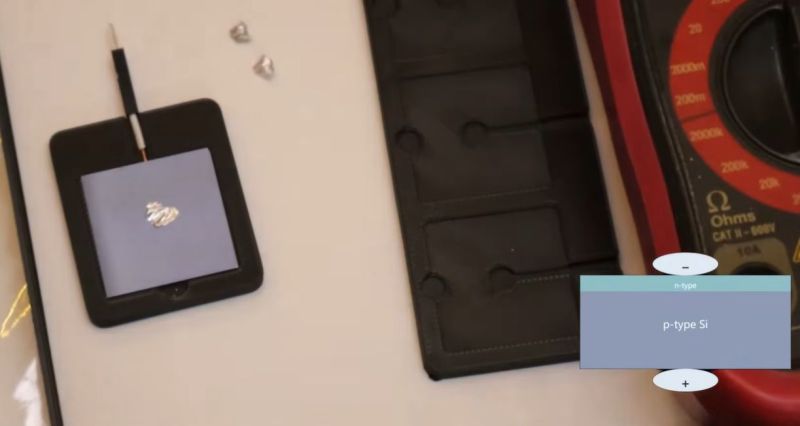
Although solar panels may seem like a kind of magic, they’re really quite simple devices, in their silicon form featuring nothing but the p-type silicon wafer and an n-type layer doped with e.g. phosphorus. Because of this simplicity it’s quite possible to make your own solar cells at home using only a few basic, off-the-shelf ingredients and a kiln, which in this recent video by [Dr. Semiconductor] uses a microwave kiln and thus justifies the video’s title.
Even the silicon wafer that you start with can be easily purchased online, though you have to be careful that it’s a bare wafer, without existing etchings on it. On this you need to get a phosphorus-rich layer, which is done by creating a delicious mixture of 1 mL of tetraethyl orthosilicate (TEOS), 0.3 mL of 85 wt% phosphoric acid, 5 mL of ethanol and 0.25 mL of distilled water. After low heat boiling this for 30 minutes, it is spincoated onto the cut square of silicon wafer using a spinning platform, like a PC fan.
Next, you shove the coated silicon into the kiln and put it into the microwave to bake at a fairly low power level for half an hour. In the video it took less than 50% power of the microwave to not melt the silicon, so remember that those microwave kilns get pretty hot.
With the delightful smells of freshly baked silicon now teasing your nostrils, you can then take out the doped silicon to sand or etch off the thin layer of glass that’s formed around the new PV cell. On the clear spots you can now put a gallium-indium contact on the p-type Si side and a wad of indium on the newly doped Si-P side, which are now your contacts for the PV cell.
The full recipe along with many of the issues discussed in the video can also be found on the blog article, though the video conclusion notes that many improvements are still possible. The created PV cell in the video reaches an efficiency of about 5%, but this could be improved through changes like the use of a clean-room, adding an anti-reflection coating and improving the contact with the cell.
AMD GAIA 0.25 is out this week as the latest feature release for this open-source project that began as "Generative AI Is Awesome" and is now going on a tag line of "AMD's open-source agent factory" in building/using local AI agents on AMD Ryzen AI hardware...
Bicycles are the ultimate form of transportation freedom. They’re easy to repair, parts are cheap, and they will travel almost anywhere for free, as long as the rider has enough calories. Their only real downside is dealing with car-dependent societies, but once a year there’s a place in the American desert that eschews all of this and [Attoparsec] decided to take this custom cargo bike modified into an RV out to Burning Man, a place and time that would be perfect for a build like this.
The build started out as a cargo bike, but not many of them have cargo areas long enough to support a sleeping human. To increase this storage capacity, the bed was extended towards the rear. Without moving the axle further back, though, this created a problem with tail-heaviness so two trailer jacks with wheels were added to the back to keep it from occasionally tipping up too far. The sleeping enclosure was built with rigid foam insulation and taped together, in a modified style common to the Burning Man event which helps keep out sun and playa dust. The bicycle recived one last upgrade to the chain to support the extra weight, and a solar-powered refrigerator, and then it was off to the desert.
The bike RV worked well in the end, and even handled a rain storm without the roof leaking. There were some problems with the customized drive train which were solved in the short term by pounding on one of the wheels occasionally with a hammer. [Attoparsec] left the event early for other reasons, though, and might not be back for a while. But vehicles like these are gaining in popularity, presuming there are safe places to ride them. [Paul Elkins] is often making ones like this gas-powered bicycle and trailer camper.
joshuark writes: Professor Christopher Marquis makes a provocative argument about business schools: "We need to abolish them." A 20-year business educator at Harvard, Cornell and Cambridge, Marquis argues in The New York Times and on LinkedIn that MBA programs sanctify profit-driven dealmaking at the expense of public life. "That's not the institution failing," he writes. "Sadly, it's the institution working." "Business school doesn't just hand out skills and a network," argues Marquis, "it quietly reshapes how people see the world, rewarding dealmaking, simplification, and optimization for financial metrics, while workers and communities become afterthoughts."
Marquis points to research suggesting that business-school-trained CEOs often benefit shareholders at the expense of workers, without delivering measurable improvements in company performance... "[W]hen a business-school-trained CEO takes over a firm, wages fall and labor's share of income drops, with no gain in productivity," writes Marquis. "In both the U.S. and Denmark, what passes for the 'managerial skill' of business-school graduates turns out to be a transfer of wealth away from workers and toward shareholders. Students deserve better than a machine that narrows their sense of what's possible."
Pennsylvania's health department issued a health alert Monday as cases of measles in pregnancy and, in turn, cases of congenital measles have continued to increase. Before the current outbreak—which continues to rage across the state—congenital measles cases hadn't been seen in decades, the department noted in its advisory.
The alert included detailed clinical guidance for managing measles exposures and cases during pregnancy as well as cases in newborns. Many doctors have never seen such cases in their careers given the decades of successful use of the measles, mumps, and rubella (MMR) vaccine. But now, with vaccination rates slipping nationwide, the highly infectious virus is better able to get footholds in communities and spread rapidly through under-vaccinated pockets, as is happening in Pennsylvania.
As of October 19, Pennsylvania had reported 1,286 measles cases this year across 42 counties. Of those, 247 have been hospitalized, and six people have reportedly died (though the latest reported death is still pending an investigation by the state health department before it is added to the state tally).
TP-Link plans to begin assembling routers in Mississippi as early as 2027 after the FCC banned imports of new foreign-made consumer routers over security concerns. Engadget reports: The company has signed a letter of intent with manufacturer Key Tronic and, pending approval from regulators, TP-Link says stateside assembly of its routers could start at a Mississippi production line as soon as early 2027.
Once things are up and running, Wi-Fi 8 routers are expected to be among the first TP-Link products that Key Tronic assembles. TP-Link claims that the agreement is part of its "long-term effort to accelerate US investment in high-tech manufacturing and job creation, designing and assembling next-generation products for American consumers here on American soil."
The company said it will still have to source components from outside the US. "Many [components] are just not available from a domestic source, and this is not a TP-Link issue," TP-Link's corporate affairs officer Steve Kovsky told PC Mag. "This is an issue for all manufacturers that are trying to onshore manufacturing."
In addition to introducing the new Intel BFF driver, the Error Detection And Correction "EDAC" kernel subsystem is sunsetting a number of old hardware drivers due to increased noise to AI/LLM-generated bug fixes for these likely unused or minimally used drivers...
Longtime Slashdot reader fahrbot-bot shares a report from ProPublica: A few months into President Donald Trump's second term, political appointees at the Department of Homeland Security (DHS) wanted Cybersecurity and Infrastructure Security Agency (CISA) to secretly acquire a voting machine and hack it. The appointees wanted the Cybersecurity and Infrastructure Security Agency to procure the machine, examine it and report back the findings so they could be given to the White House, according to two former administration officials with knowledge of the request.
The proposition was shocking to CISA's career staffers, according to one of the former officials. CISA typically worked to thwart hackers. Moreover, the agency had been directed not to alert the voting machine company if it uncovered flaws, contrary to its standard practices. The request made the CISA employees fear they were being asked to take part in political interference. "My thought was they could keep it in their back pocket to invalidate any [election] results they don't like," one of the former officials said. "This goes against everything CISA represents." [Or, perhaps do something worse?]
The CISA employees repeatedly told the political appointees that their request was impossible, in part because the agents capable of pulling off such an operation had just been laid off by Elon Musk's Department of Government Efficiency (DOGE) initiative. The appointees eventually stopped pressing CISA. Though not acted on, the request shows how the Trump administration has tried to use the agency for its own ends while draining it of resources for one of its critical missions: protecting the nation's voting systems.
A Russian military satellite maneuvered in "extreme proximity" of a commercial Earth-imaging satellite in recent days in the first known example an unsanctioned rendezvous in low-Earth orbit, according to the orbital intelligence company LeoLabs.
The Russian spacecraft, Kosmos 2612, "conducted a deliberate series of maneuvers toward ICEYE-X36, a US-operated commercial imaging satellite," LeoLabs said. "Kosmos 2612 closed from hundreds of kilometers away to extreme proximity to ICEYE-X36. It then maneuvered around ICEYE-X36, remained nearby for an extended period, and then began moving away."
US military officials and independent analysts have tracked Kosmos 2612 since its April launch on a Soyuz rocket from a spaceport in northern Russia. Within weeks, it became apparent that at least four of the six satellites from that launch were stalking ICEYE-X36 after they adjusted orbits to line up with the orbit of the ICEYE spacecraft.
In a court filing Sunday, US attorney Craig Missakian argued that Abdulrahman Alfozan must continue to be detained while the US makes its case that Alfozan brazenly spied on OpenAI, either for his own personal business gain or to benefit the Kingdom of Saudi Arabia.
Evidence showed that Alfozan had been chatting with a member of the KSA royal family on WhatsApp, while pursuing opportunities to permanently move back to Saudi Arabia during the country's biggest AI push yet, the government argued. Shortly before his arrest, the FBI found he accessed a folder called "Saudi Gov Docs" on his iPhone, where he also allegedly stored photos of a second bug he planted in the offices.
The first order of business for the energy transition is electrifying applications like vehicles and heating and making sure that the electricity that powers them is made using renewables. But once the dominant slices of the emissions pie have shrunk, other categories with less potential to reduce emissions become important.
A new study led by Haiwei Zhou at the University of Melbourne focused on the emissions associated with making lithium-ion batteries, which many parts of the energy transition rely on. Those emissions aren’t zero, so as we use more and more batteries, that number will grow. Right now, the researchers estimate that these emissions only account for 0.18 percent of annual greenhouse gas releases, but they could increase by a factor of 10 or more by 2050.
Avoiding production
There are a number of ways to reduce the emissions required to make a battery. Some elements used in various lithium-ion battery chemistries are more energy-intensive to mine and refine than others. The battery manufacturing process involves many steps that could be made more energy-efficient. And then there’s recycling, which can put battery materials back into the loop while requiring much less energy than mining.
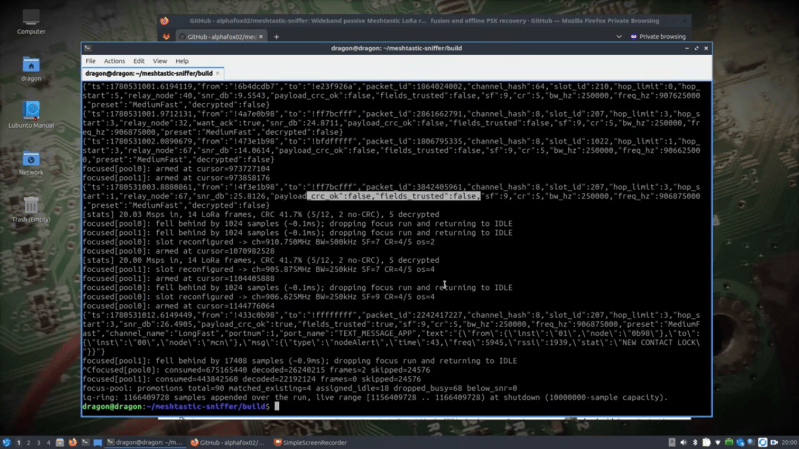
Meshtastic has gained a lot of popularity over the last few years thanks to its low barrier of entry. No licenses are needed and the hardware is dirt cheap, at least when compared to a lot of ham radio gear. But while that physical barrier is low, there is a bit of a learning curve. Part of that comes from the fact that there are a lot of channels and modes that people could be communicating on, and unless the user knows that information up front it can be hard to find where the conversations are happening. [cemaxecuter] noticed this problem and built a Meshtastic sniffer into his radio-forward Linux distribution, DragonOS.
The sniffing software is built in C and comes as a complete standalone binary and does not rely on GNU Radio. With DragonOS up and running and the software loaded, it can look at the entire bandwidth that Meshtastic operates on and detect any traffic and decode it (as long as the key is known). [cemaxecuter] is using a HackRF as a software-defined radio for this project, which he notes doesn’t quite have enough bandwidth to cover every Meshtastic operating frequency, but it can get most of them. After firing up his own node, the software quickly detects it and shows its details in the terminal.
Software like this opens up a lot of opportunities for things that would be tedious, difficult, or impossible to do with with a standard Meshtastic node. Besides finding places where conversations are happening more easily, [cemaxecuter] also suggests that it could be used for wardriving and for locating or finding other networks much more easily. For those who still haven’t tried it out, take a look at this 2023 treatise on the protocol and hardware and then dive right in.
An anonymous reader quotes a report from The Verge: A hacker broke into more than 100 websites using an army of AI agents that mostly operated on their own, according to findings from the AI security firm Norforge. Though Norforge doesn't name the targets, Reuters reports that the victims included companies like John Deere, SharkNinja, and Cummins.
[...] Researchers at Norforge uncovered the attacks through exposed work on Cairn, an open-source AI platform that describes itself as a "general-purpose problem-solving engine." With Cairn, users set a start and end point for the AI agents, which document their progress as they move forward with the task. However, as noted by Norforge, hackers can also use the tool to orchestrate cyberattacks using AI agents.
The hacker who broke into more than 100 sites was the "most active" among the exposed Cairn instances discovered by Norforge, waging attacks on companies based in the US, Canada, Australia, and Japan, as reported by Reuters. This attacker laid out "preferred intrusion tactics" using fewer than 100 Chinese characters, with successful breaches taking about 23 hours, according to Reuters. Overall, Nordforge found more than 20 exposed Cairn instances that are "likely malicious." A John Deere spokesperson said there is "no indication that sensitive information was accessed" as a result of the attack, while Cummins said it's "investigating the report of a potential cyber-attack on a website operated by one of our third-party vendors."
Meanwhile, SharkNinja says the breach impacted a standalone site with product support information, and that it has contained the threat.
Recently fixed vulnerabilities in the Plex Media Server are under active exploitation in attacks that, when successful, install malware, including cryptominers and residential proxy apps, a researcher said.
Plex fixed four vulnerabilities at the start of last month. Three weeks later, published CVE designations revealed five vulnerabilities, with one of them carrying a severity rating of 8.6 out of 10. A researcher last week revealed an exploit that chained four of them together to achieve remote code execution of the device running a vulnerable Plex version. The researcher named the chain "Plex2Shell."
Complex exploit chain
The new details allowed a separate researcher to create a honeypot that could track attempts in the wild to exploit the vulnerability chain. Within a day, the researcher began seeing active scanning of the simulated Plex server and eventually successful attempts to infect devices. So far, successful attacks are installing two payloads. One is a cryptominer, which uses the device to mine cryptocurrency and deposit it into a wallet controlled by the attacker. The other payload is residential proxy software, which allows people to anonymize their Internet activity (much of it illegal) by connecting to the infected box and then using it to send the user’s traffic to a final destination.
Following its October 13 HomeView launch, Apple is gearing up for its second hardware event of the month. The event is scheduled for October 28 in Los Angeles and carries the tagline "Pro and tell." 9to5Mac reports: Rumors say Apple has a slew of new products to announce at its next event, headlining by its first MacBook Pro with a touchscreen and OLED. According to Bloomberg's Mark Gurman, here's what's on the docket:
- New 14-inch and 16-inch touchscreen MacBook Pro models with OLED displays. They will also have a Dynamic Island for the first time and will be "significantly lighter" than the current models. The new MacBook Pro models are expected to be powered by the M5 Pro and M5 Max chips.
- A revamped iPad mini with an OLED screen, a "revamped speaker system," and a relocated FaceTime camera
- New iMac and entry-level 14-inch MacBook Pro models powered by the M6 chip, which will "look like their current versions."
The world’s first demonstration of a subsea geothermal power plant has taken place near an active underwater volcano almost a mile below the ocean surface. It generated less than 10 seconds of net-positive electricity but showed the technical feasibility of tapping another form of renewable energy underwater.
The three-week test deployment of the 3-ton prototype power plant took place at the Axial Seamount in the northeast Pacific Ocean in September. Endurance Energy, the Seattle-based startup behind the effort, aims to eventually commercialize subsea geothermal power for Pacific island nations and other customers looking for alternatives to importing expensive fossil fuels.
“The deep ocean gives us unlimited cold seawater for cooling, and its weight keeps the system and the well pressurized, so our plants can be compact,” said Andrew Redd, founder and CEO of Endurance Energy, in an email to Ars.
Florida's DMV says a September 4 breach exposed driver's license and motor vehicle records after attackers obtained credentials that a local law-enforcement employee had "improperly stored on an electronic device." The ShinyHunters group has been linked to the intrusion. Ars Technica reports: In a notice posted Friday, [Florida Department of Highway Safety and Motor Vehicles (FLHSMV)] confirmed that it took "immediate steps" after discovering that "a malicious actor accessed certain department records on September 4, 2026, using compromised credentials." There's "no evidence" that data has yet been misused, the department said, but law enforcement "determined the information potentially affected includes driver license and motor vehicle data, to include document images, and other personal information."
[...] On a webpage describing the security incident, FLHSMV confirmed that an "international cybercriminal organization" was behind the breach but did not specify which group or how long they had access. Instead, officials claimed to have "promptly mitigated the breach, launched an investigation, and issued required notification to state authorities." Mitigations included "blocking unauthorized access, resetting relevant user credentials, engaging cybersecurity professionals, and implementing additional safeguards to protect sensitive information," FLHSMV said. Florida's investigation is "ongoing," officials said, but a cybercriminal group called ShinyHunters -- which recently claimed credit for hacking the FBI -- may have stolen the data. Florida residents affected by the breach will receive a letter offering one year of free credit monitoring through Sontiq, Inc. Those whose contact information is outdated can email the FLHSMV at [email protected] to determine whether their data was compromised.
Open source Windows alternative ReactOS has reached a major milestone: The operating system can now be installed directly onto an NT Files System drive partition. As reported by Phoronix, the move to NTFS clears a long-standing hurdle for the project and brings it one step closer to finally reaching beta.
Prior to this latest announcement, ReactOS required users to keep a FAT32 partition for installations. A proprietary Microsoft-developed filesystem, NTFS can trace its roots back through the Windows NT family lineage starting in 1993 with Windows NT 3.1. The variant introduced with Windows XP in 2001 remains the standard used by most Windows systems today. With ReactOS's stated goal of reaching binary compatibility with Windows Server 2003, being confined to FAT32 partitions was a practical barrier to clear on the way to reproducing the Windows environment.
However, users looking to hop off the Windows train shouldn't be grabbing their bags just yet. ReactOS wrote that the new driver still "lacks caching (which causes inferior performance), journaling and security support." So while the new driver is here, even the most intrepid of OS tinkerers should tread carefully. The ReactOS team warned in its announcement on X that there are still "potentially undiscovered bugs."
With Linux 7.3 there are some nice Btrfs performance improvements to enjoy while the in-development Linux 7.4 kernel is set to bring some additional performance optimizations for this copy-on-write file-system...
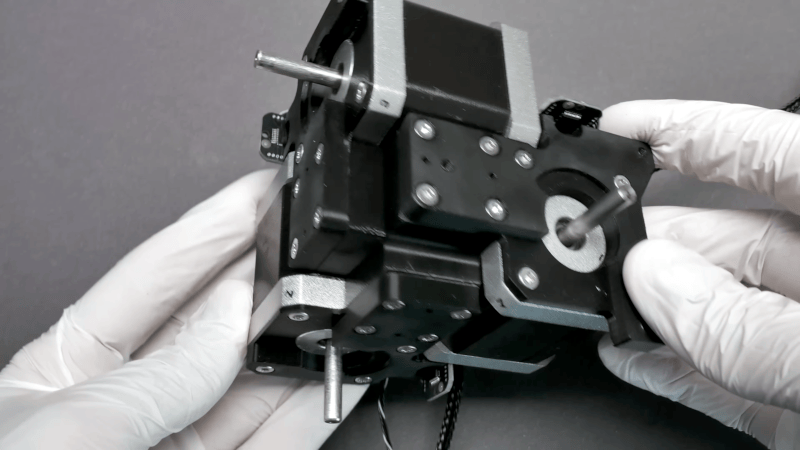
If you need a micro-manipulator, you probably already have a good idea of what it does. For example, you might be moving a probe over an IC die or wafer. You might be looking at something through a microscope. The key is moving something in very small, precise increments along three axes. An open-source design for a micro-manipulator has seen significant improvements lately. You can see several videos about the device below.
The device uses stepper motors, parallel kinematics, and miniature ball joints to achieve precise motion. The recent version 4.0 update fixes a few problems. According to the GitHub page:
Self-collision during homing fixed.
Connection of the ball joint block with screws only was not well constrained and could be rotated a bit.
No reliable way to ensure consistent linkage rod length
Unnecessary ball joint friction
Accurate ball position heavily dependent on print quality and corner rounding
Rubber bands could not be changed or removed once glued in.
We’ve covered earlier versions of this device, and we were watching the improvements to the ball joints. Since then, the project has updated much of its mechanical design and documentation, and it has also changed the API that drives it. It can even use tools in g-code now to support things like fine control over laser engraving.
If you prefer something old-school manual, consider a 3D-printed one.
An anonymous reader quotes a report from CNN: Elon Musk has said he will give every child in America a stake in SpaceX, his $2 trillion aerospace and artificial intelligence company, as tech firms face intensifying scrutiny over their impact on society. "Next year, I will give one of my SpaceX shares to every kid in America," he wrote on X on Monday. "This will be the first of many."
SpaceX only began trading publicly in June (and after the biggest initial public offering in history). The company's shares were trading for about $146 when the market closed on Friday. Musk's proposal was thin on detail. It is not clear how those shares would be distributed to the tens of millions of American children or whether all of them would even be eligible. According to the United States Census Bureau, there are roughly 73 million people under the age of 18, making Musk's potential giveaway worth about $10.7 billion at SpaceX's current share price. The move came in response to Anthropic's announcement on Sunday that it will commit at least 5% of its shares to a "Public Benefit Fund" that will donate money to social causes. "I recommend giving the shares directly to the public," Musk said in a reply to Anthropic's announcement. "This is what I will be doing."
Wine has been successfully ported to OpenBSD, with developers reporting that dozens of 64-bit Windows applications now run on the operating system. "Even the Remaster of The Witcher 3 which released just last month runs, and runs well," writes Thomas Frohwein, OpenBSD developer and ports maintainer. OSnews reports: The biggest limitation seems to be the lack of support for WoW64, so 32bit Windows software won't work. Still, this is a massive milestone for OpenBSD, and makes especially gaming a somewhat viable option on OpenBSD.
An Intel engineer opened the pull requests today for adding Intel XeSS support to Valve's Proton for Steam Play along with associated changes to VKD3D-Proton and DXVK...
Developer Alliance Arts highlighted this trend over the weekend, delaying the launch of a planned public demo for its demon-themed Russian Roulette drinking game Drunken Goddess Reflex, which had been set to go live with today's launch of Steam Next Fest.
In a post on social media Friday evening, the Alliance Arts team wrote that, in addition to concerns about managing streaming restrictions, "we're concerned that the demo's content could be used to quickly imitate or replicate the game's presentation and gameplay with AI or other tools and that such works could be released before our launch."
Huge DMV data breach impacted current and former Florida residents
Posted on Oct. 19, 2026, 12:38 p.m. | Ars Technica
The Florida Department of Highway Safety and Motor Vehicles (FLHSMV) has begun notifying victims impacted by a recent data breach of driver’s license and motor vehicle data, but not everyone whose information was stolen will receive an alert.
In a notice posted Friday, FLHSMV confirmed that it took “immediate steps” after discovering that “a malicious actor accessed certain department records on September 4, 2026, using compromised credentials.” There’s “no evidence” that data has yet been misused, the department said, but law enforcement “determined the information potentially affected includes driver license and motor vehicle data, to include document images, and other personal information.”
FLHSMV is sending out letters to everyone affected, offering victims one year of credit monitoring from Sontiq, Inc. However, the state acknowledged that it may not have current contact information for many former Florida residents’ whose data was still being stored. Those potential victims can confirm if their data was stolen by emailing FLHSMV at [email protected], officials said.
Last week I wrote about Linus Torvalds leveraging AI to come up with a hefty Linux kernel improvement using Claude Code. The code is for reading from the page cache without folio references to help workloads of small reads from a single file across many CPU threads. Meta engineer Kiryl Shutsemau has taken that code and reworked it and showing extremely promising performance results...
The Motorola 68000 "m68k" CPU support continues being maintained in the mainline Linux kernel and continuing to see new hardware support for these vintage systems from the likes of Commodore Amiga, Atari, and early Apple Macintosh models...
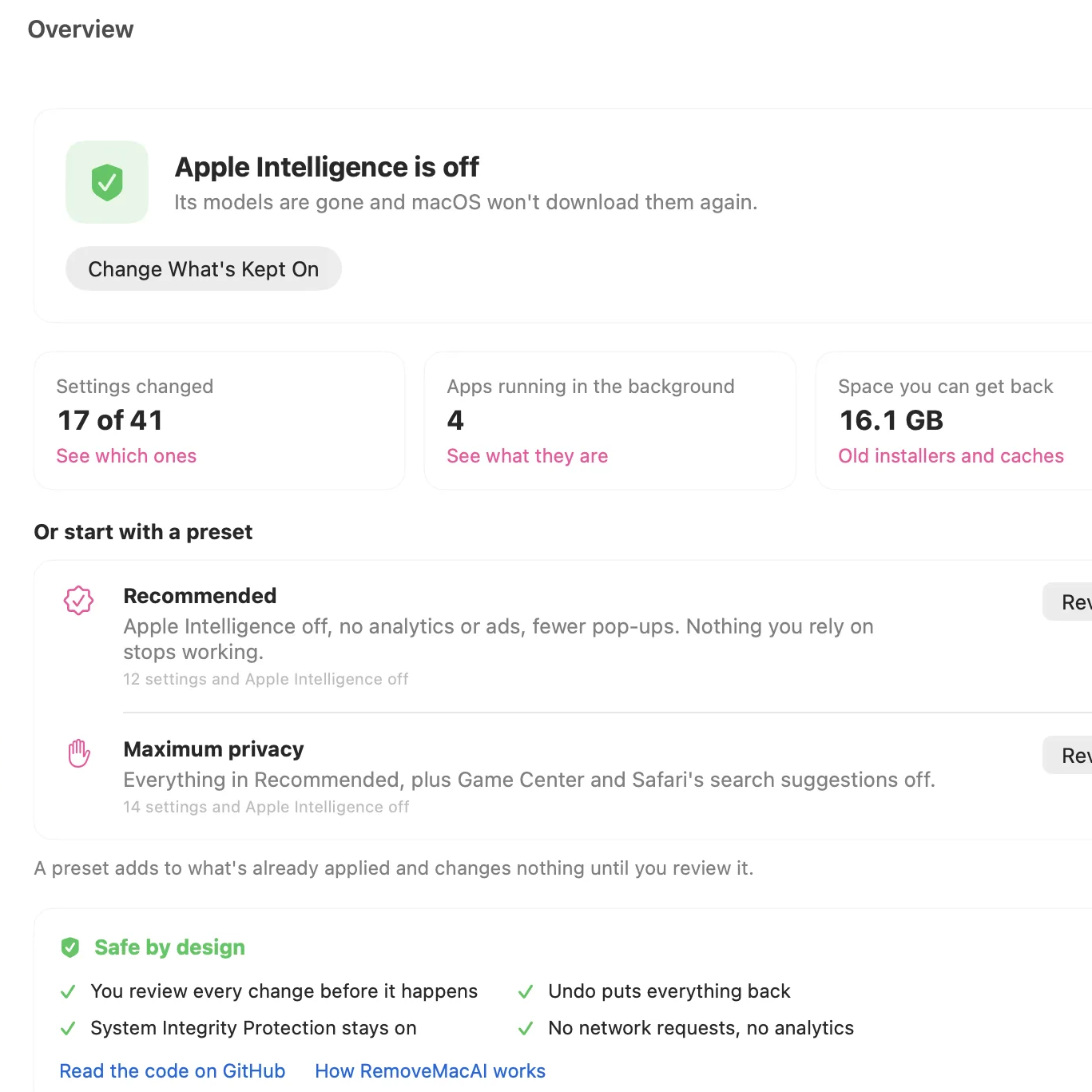
Don’t want AI features on your Mac? Tough luck, unless one wants to imperfectly do it by hunting down settings in about a dozen different places. Even then, the multi-gigabyte models stay on disk. Unsatisfied by this state of affairs, [omlahore] created RemoveMacAI, a one-stop-shop debloater that shows Apple Intelligence the door, reclaiming its disk space on the way out.
With RemoveMacAI one has a single location from which to turn individual AI features off, delete the models behind them, and block MacOS from downloading them again by redirecting attempts to a closed local port.
What’s refreshingly nice about the tool is how transparent it is about what each setting or preset will change, and communicates clearly what exactly one loses access to by disabling it. Want it all gone? Easy. Use one or two features, but don’t want the rest? No problem. All changes are shown up-front before the tool changes anything, and all alterations are reversible.
Released only a couple weeks ago, to say the tool is popular would be an understatement. Windows 11 also got a “remove AI features” tool, and it requires constant updating to stay functional. Will a future MacOS update interfere similarly with RemoveMacAI? Probably, but one thing that is clear is that a tool like this resonates deeply with a nontrivial number of users.
Nathan Fielder and Lance Oppenheim's Elizabeth Holmes documentary "You Can See Everything" earned more than $15 million in its limited opening weekend, making it one of the biggest documentary launches in decades and the strongest opening for a film on fewer than 1,000 screens since Borat in 2006. It was also "the biggest non-music documentary since 'Fahrenheit 9/11' in 2004," adds CNN. From the report: Many weekend screenings in cities like New York and Los Angeles were sold out despite the three-hour running time. The film's distributor, A24, called it "one of the largest limited-release openings of the 21st century." "You Can See Everything" opened on fewer than 900 screens following a jaw-dropping surprise premiere at the Telluride Film Festival last month.
Fielder and Oppenheim worked on the project in secret for years, filming with Holmes and her partner Billy Evans in the weeks before Holmes went to prison in 2023. Holmes was convicted of wire fraud and conspiracy to defraud Theranos investors, but she tried to convince the filmmakers of her innocence.
Fielder, who appears on camera interviewing Holmes and Evans, takes the film in unexpected directions, thrilling critics and theatergoers. The film has an extraordinarily high 99% "fresh score" on Rotten Tomatoes and a record-high 4.8 rating on Letterboxd. Further reading: Will New Documentary Make Theranos Founder Elizabeth Holmes More Sympathetic?